
Recently, Ohio Workforce Coalition and other statewide partners commissioned the Center for Community Solutions to compile data regarding top occupations in Cuyahoga County in which workers are potentially impacted by the benefits cliff. (See below for a quick reminder of my understanding of the “benefits cliff”.) Here are the top five, according to the Bureau of Labor Statistics:
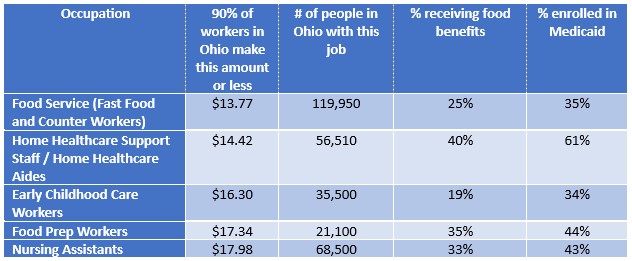
I’m struck by the importance of these positions, the fact that these 250,000 Ohioans provide critical services, and have in my own life and in the life of people I care about. Those we call “essential workers” are paid so little they must access public benefits to make ends meet.
Furthermore, some of these benefits change more quickly than others. Housing subsidies change even with a small income increase. For example,…..
It’s easy to say the solution is to “pay people more”! But there are real reasons these roles don’t pay rates which enable people to earn enough to overcome their own individual benefits cliff. So, with an eye towards identifying pragmatic opportunities to advance potential solutions and discussion, here are a few ideas I’ve heard about:
-
-
- Work with employers who are so inclined to more rapidly train individuals on career paths in industries which pay people better. A company can build a competitive business strategy, one which attracts talented people, based on individuals doing this work for a relatively short time, and then being referred into other higher-earning career paths
- Investigate and pilot innovative approaches to helping individuals earn more (with funds going into a fiscal agent or trustee account) so they can earn more over time, save money, and not lose their benefits until they are able to earn an amount sufficient to offset the benefit loss
- Consider how we can address increased public reimbursement rates for some of these critical roles, for which their hourly wages are based on public reimbursement rates (such as in healthcare)
- Learn more about the Universal Basic Employment pilot led by Devin Cotten, in which individuals would agree to give up their public benefits in order to earn a true living wage ($50,000+ a year)
- Deploy public economic development strategies in a way that incentivizes employers that offer quality jobs and workplaces.
- Give priority access to public funding for training (SkillUp, TechCred) to quality employers that invest in their workers and help them to advance/mitigate the cliff.
-
Other ideas?
Note: “Benefits Cliff:” Let’s start with benefits. Many people impacted by poverty, including those working in very low wage jobs, receive public benefits to enable them to survive, such as food, childcare or housing subsidies, Medicaid benefits, etc. These benefits are greater for a very low-income person (such as a person earning $10/hour) and they reduce as a person makes more income (like, $15 or $20/hour). This is logical. However, the devil is in the details, and often, the rate at which people lose benefits is greater than the increased income they can make as they lose the benefits. For example, for a $1/hour wage increase, a person could lose $300 in childcare subsidies a month. Because a person typically doesn’t work 300 hours a month, they make less money by earning a greater salary, and so are logically inclined to turn down an increase in wages. The benefits cliff starts when people earn as little as $15/hour and people don’t “make it up” until they make $30/hour or more.