
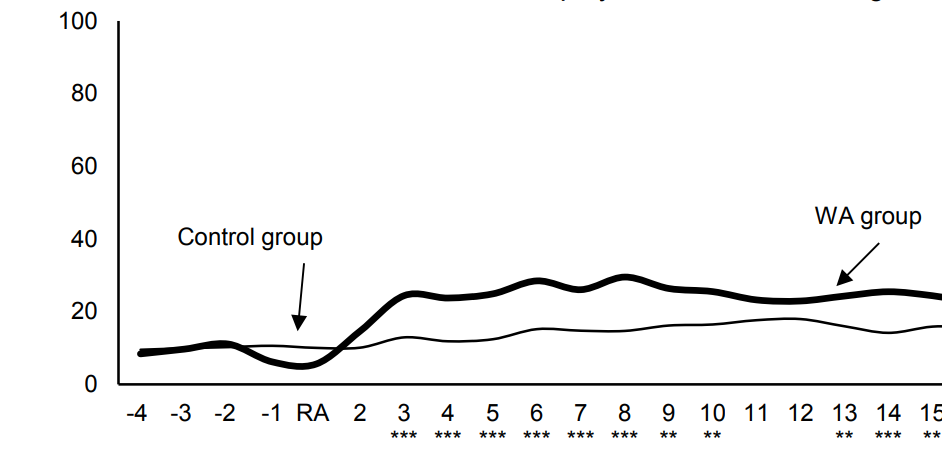
Visual from "Long-Term Effects of a Sectoral Advancement Strategy”, March 2020, MDRC (Kelsey Schaberg and David Greenberg)
I believe that workforce development programs enable people to make more money as a result of completing the program. The WorkAdvance study, a national study that also worked with local provider Towards Employment, evaluated completers’ earnings at 2, 5, and 7 years post workforce training (where the training was aligned with local employment needs; it was manufacturing and healthcare here in Ohio.) This study shows that people make more money ($4100+ annually more) in at least the first several years, for employer-aligned training programs with the right program design.
Is there a way to better understand the long-term earnings trajectory of people after workforce programs? To develop a local capacity to understand this on an on-going basis? To better understand who is being most helped, to what degree, in what fields/occupations? To inform the many decisions made every day about how to best implement workforce programs?
I am working with a small group of people to think through these questions, and one of the steps I’ve taken to consider this is to look at other markets and other studies. Here are some of the encouraging reports which confirm what we believe and know from WorkAdvance:
-
-
- A report for Skills for Chicagoland’s Future evaluated earnings impact and employment retention, among other topics, of a job matching initiative for 2 years of follow-up. In this report, there was consistent average increase in annual earnings (for the 2 years) from the initiative, ranging from $4K (for retail and food service roles) to $11,000+ (healthcare and business/financial service roles). Retention was also higher (11% higher at end of 2 years vs. those not attending training). Job matching can be effective.
-
-
-
- Partners for a Competitive Workforce completed a wage study of 6,100 individuals across three career pathways. Over 4,600 earned credentials and 82% earned employment (75% of the total retained that employment 12 months later.) IN this research, everyone who participated in a workforce program had earned at least $100 more per month during that first year, with those earning a credential tied to an occupation making $200 more per month and those earning a licensemaking up to $700 more per month. (The limitation was that this was only measured for 12 months post-employment.) Upskilling can be effective.
-
-
-
- A Return on Investment study conducted by the Greater Cincinnati Workforce Network looked at the financial return of a healthcare employer paying for a training program for its own associates. UC Health trained existing workers in low-skill jobs for occupations requiring associate degrees. The costs were $1.8 million, whereas the benefits were $2.0 million (due to recruitment cost savings), providing an ROI to UC of 11.9%. This same study looked at the ROI of hiring people who had completed certificate training programs. There, the benefit was almost $5K per employee in reduced turnover and recruitment costs, with total benefits of $2.6 million. Employers see impact from engaging with workforce development partners.
-
These studies reflect much shorter timeframes post-workforce program than the WorkAdvance suite, and are one-time studies (compared with an ongoing capacity and tracking.) We know we can learn more with a more comprehensive approach. But these represent high quality (statistically-significant) validation of workforce programs – particularly those aligned with the needs of local, good employers – to increase the earnings potential of program completers.