
With the changes in Federal policy and programming coming fast and furious, it can be hard to keep track of them, and to understand them (such as the implications and details of the recently passed Federal budget.) Here’s where I turn to national partners – those organizations, often located in Washington DC – which have as a key part of their mission to keep track of and lobby for Federal policy. Here’s a list of the organizations and websites I have on bookmark to help me better absorb and consider all the Federal changes. (Keep in mind that these organizations also have their own policy agendas, so be aware that what they cover and how they cover it is aligned with those agendas.)
1) Center for Community Solutions: Yes, I consider them a national partner, even though they are located right here. The caliber of their work is second-to-none, and they focus on both national and Ohio policy issues for the social services sector and beyond. Look on their site under topics and in particular, Poverty and Safety Net issues.
2) National Skills Coalition: They have been one of the most active at following and communicating about national workforce policy, and translating it at the local level. I follow both their news feed and their blog, where I found one of the best visuals of the implications of the national budget:
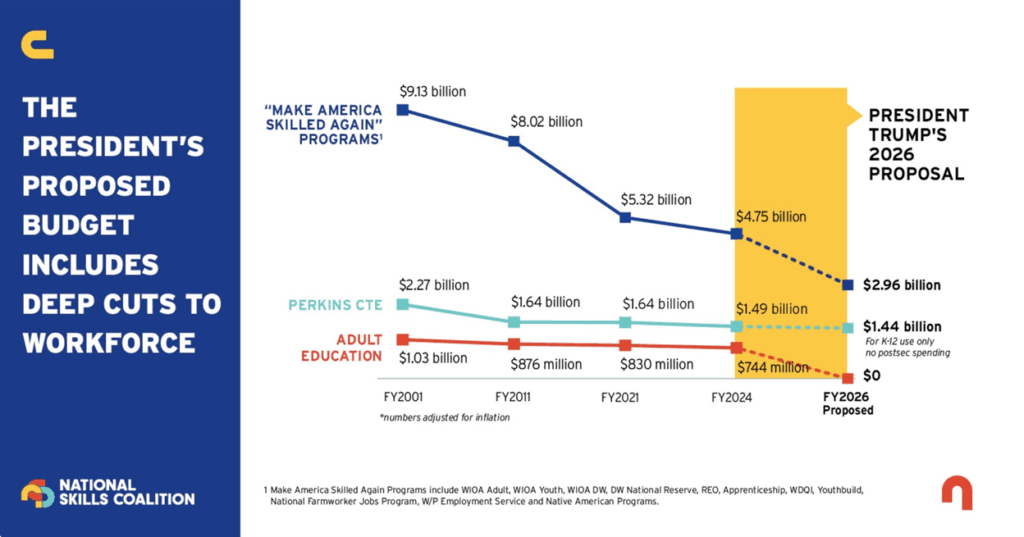
3) Committee for a Responsible Federal Budget. Non-partisan, but focused on responsible spending, this organization is covering the Federal budget to a degree that is almost “too much of a good thing” for me. But they cut right to the chase and they help me when things are moving very very quickly. This will be a go-to in the coming weeks.
4) Jobs for the Future: They don’t write about this work as robustly as NSC but some of their blogs are real bangers, such as this one with details about the impact on Dept of Labor and Dept of Education work.
5) Center on Budget and Policy Priorities: This is a go-to site which covers the budgets and funding broadly (with a focus on a lot of areas which connect to workforce but don’t include workforce). Besides that, they are one of the only ones which is focused on both Federal and State budget and policy information.
6) Urban Institute and particular, their Work, Education and Labor articles. I like their focus on connecting workforce with the public education system, and in fact, they just announced a new essay series on the new and emerging federal K-12 policies and the implications on people and places, with the first essay on implications for student access to school meals based on changes to SNAP and Medicaid. More to watch in the coming months.
If you find other good sources, I’d love to know and share.