
Deaconess Foundation is paying attention to artificial intelligence and how will evolve work and the skills needed of workers now and in the coming weeks and months. How are we paying attention?
1) We have invested, together with others, in the application of some exciting new technologies (such as Arena Analytics).
2) We are paying attention to the ways businesses are rapidly testing and learning themselves,
3) We are actively using basic AI ourselves (ChatGPT on our phones, so we use it every day) and
4) We are taking advantage of opportunities to get smarter.
We know this list should probably get longer…please share your ideas for other things we should be doing!
To item #4 on the list, I recently attended a forum hosted by GCP, together with Accenture, CWRU, and others, on the value proposition for businesses of Generative AI. Some of the discussion built upon learning we gleaned from Burning Glass last spring. At that time, I shared one of the most interesting summaries I had seen, which was the jobs that were likely to be at risk – or to evolve very significantly – as a result of generative AI. (See picture below.)
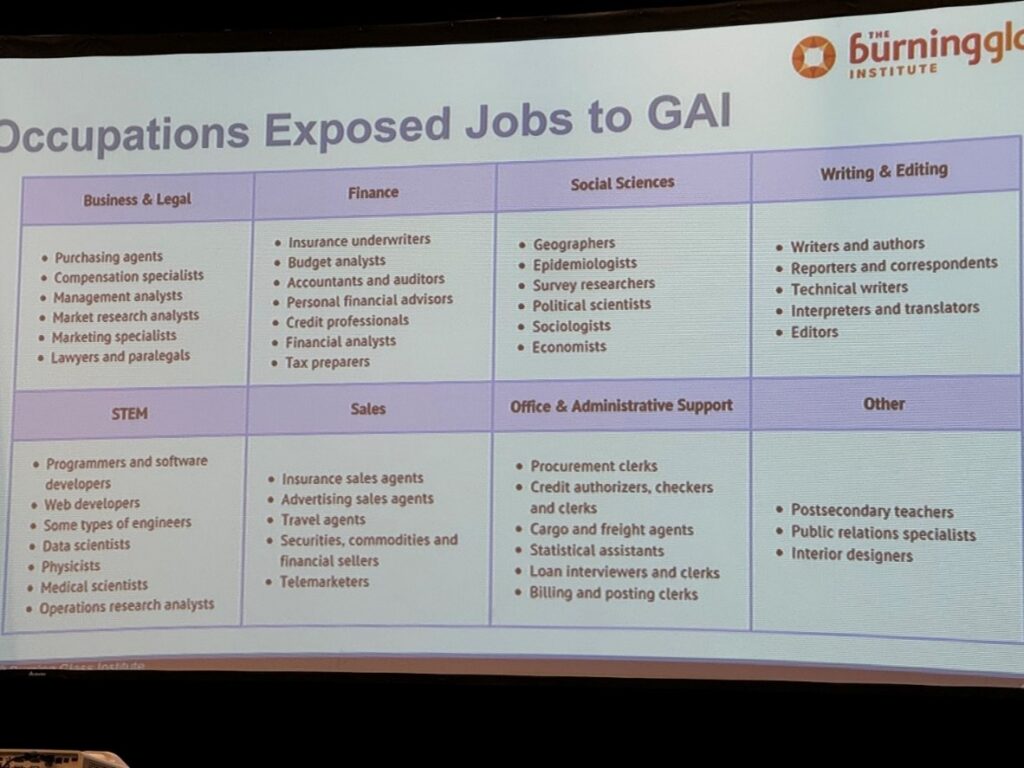
I’ve continued to believe, because I’ve heard it so often, that the fear that jobs will “go away” because of AI is unfounded; however, jobs will certainly change, and the skills workers will need for the same jobs, and for the new jobs that will result, are different.
In the GCP forum, I heard a refinement on that thinking which I found very valuable. Within a body of work: the jobs themselves which do that work today will still exist (although with new skills needed.) But the number of those jobs is likely to change (and probably decrease), with new, different jobs with different requirements taking their place.
This is more clear via this visual from Accenture’s Lee Barrett, North American Data and AI Lead:
It’s pretty hard to read this visual, but the details don’t totally matter. What is on the left is 100 jobs, split between 8 occupations. On the right, it’s still 100 jobs, and all 8 jobs on the left are there, but there are few people doing each of those 8 jobs, and 7 new roles are now added. The new roles bring different skills to the work, and complement what AI is able to do – bringing what is uniquely human (creativity, problem-solving, understanding people and relationships) to the work.
I talked with one of the business leaders who presented at the forum (talking about one of the use cases where he had implemented a GAI solution) , and asked him – once you start implementing a Generative AI solution within a particular part of the business, how quickly do you move from the jobs doing the work on the left side of the page, to needing the jobs on the right?
(Think for a minute. Put a guess on a piece of paper.)
(Thinking)
(Thinking)
(Thinking)
His answer: 6 to 18 months.
I’m more committed than ever to figuring out how we can have more visibility to the new roles on the right, and how many of them we might need. Sharing this back with our training and education institutions will help greater Cleveland continue to have a highly competitive and attractive workforce.