Ohio’s Performance in the State Opportunity Index
Ohio’s Performance in the State Opportunity Index
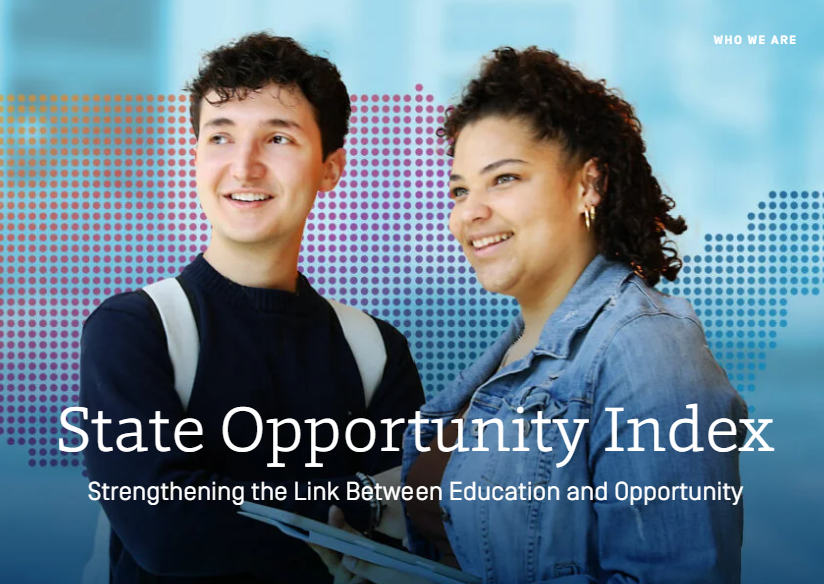
Two weeks ago, Strada Educational Foundation launched a new tool and report regarding the success of individuals who graduate high school in finding a career path, securing education (whether a certificate, 2 year degree, or 4 year degree), and earning enough to generate an ROI on that educational investment. The tool and report, called the State Opportunity Index, gives states a quantifiable set of indicators that support a stronger connection between education and opportunity. While there are still gaps in the data, the inaugural effort provides a baseline nationally, and for every state – including Ohio – to know where they stand, and to develop policies and programs which support students, educators and employers.
So how did Ohio do?
There are 5 priority areas addressed in the report: Clear Outcomes, Quality Coaching, Affordability, Work-Based Learning, and Employer Alignment. There is Ohio data on only three of them, but it’s worth considering all 5 nonetheless in hopes that we can capture Ohio-specific data in the future.
As a “rating” system, the report categorizes progress in four levels:
- Leading: State is at the forefront and has made the most progress towards creating equitable pathways to opportunity.
- Advanced: State has made substantial progress
- Developing: State is in the early stages of creating more equitable pathways
- Foundation: State is just beginning to create more equitable pathways to opportunity.
Clear Outcomes: This area is about having accurate, robust and timely data to inform stakeholders in the education-to-employment system. Maturity in this category reflects strong ability to collect education and employment outcomes data, to integrate it, to provide it to students, families and other stakeholders, and to drive impact by sharing these insights with policymakers, institutions, and employers. Ohio is Advanced in this area
Quality Coaching: This represents education-to-career coaching to help individuals achieve their education goals while positioning them for career success, including incorporating career planning within and throughout educational programs. Data at the state level for Ohio wasn’t available for this, although nationally, only 25% of 2-year graduates and 20% of 4-year graduates experienced this type of personalized coaching. Those who did were more able to secure employment aligned with their education and interests.
Affordability: This represents the number of hours a student would need to work annually (earning the state’s median wage) to cover the net price of their education (2 year or four year). Ohio is considered Foundational for four-year universities, with more than 30 hours of work per week needed during the school year and fulltime work during the summer to cover tuition. However, Ohio is Advanced for two year universities, as students would need to work 10-20 hours during the week and fulltime during summer to cover this cost.
Work-Based Learning – internships, co-ops, clinical rotations, practicums, and apprenticeships – allow students to engage in structured work experiences. Again, Ohio did not have statewide data. Nationally, slightly more than 25% of bachelor’s graduates and 10% of associate graduates had a paid internship (rising to just under 50% and 25%, if you add to this unpaid internships.)
Employer Alignment is based on the supply/demand ratio for a variety of high-demand, high wage jobs (those which promise strong earnings and continued economic advancement) and the estimated percentage of bachelor degree holders employed in these college-level jobs. Ohio is Developing in this area, with supply/demand ratio of 62%, compared to 85% in Utah and a low of 20% in Alaska.
In addition, there’s an ROI calculation which reflects the percentage of graduates who would experience a positive return on their investment in 10 years based on income distribution for college graduates in the state; a positive ROI value would mean that after working for 10 years post-graduation, the earning increase more than covers the cost of the education (all based on state level data).
Ohio’s data reflects:
-
-
- 70% ROI for graduates with a bachelor’s degree (compared to a high of 88% in Washington DC and a low of 55% in Idaho)
- 64% ROI for graduates with an associate’s degree (compared to a high of 74% in Wyoming and a low of 48% in North Dakota).
-
The value of this data is in the sharing it with those stakeholders – policy makers, education leaders, program designers, employers, and others – who can consider long-term changes to make which address and improve these statistics over time. Perhaps the best part of the Strada report is that it includes recommended questions and conversations to be had based on what the data suggests in each of these categories. I look forward to discussing this data, and the implications for change in improvement in providing equitable access to opportunities, with you!